Tips to Use Automation to Streamline Your Assembly Line in China
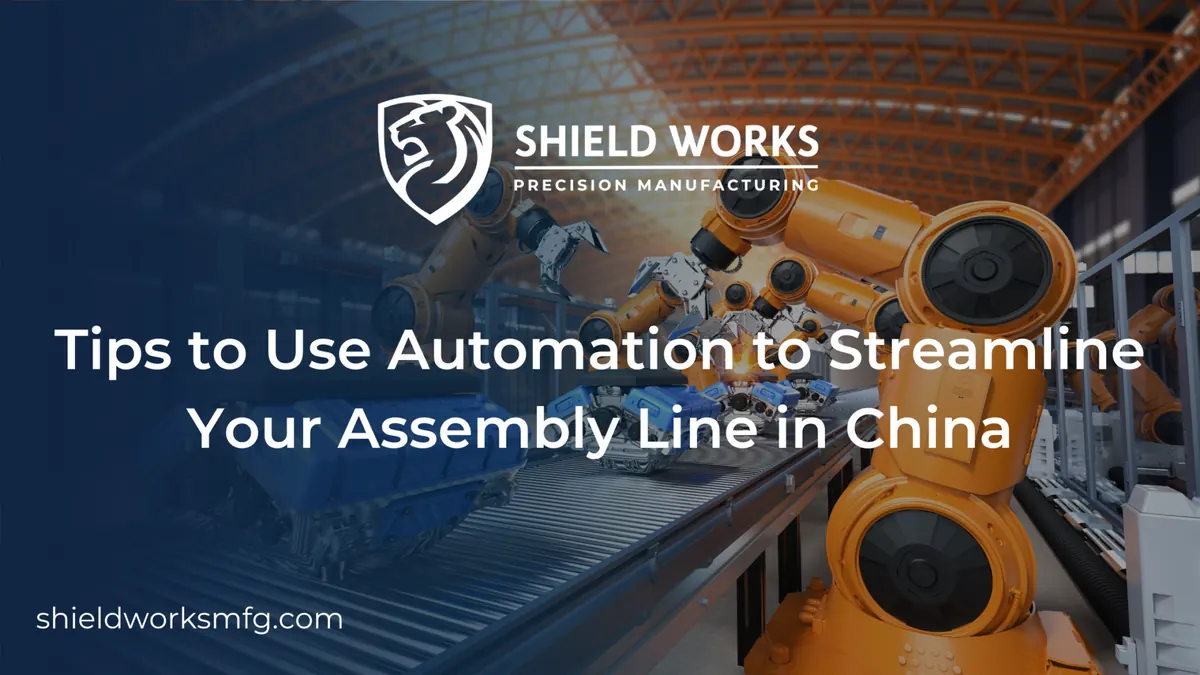
To automate an assembly line in China effectively, start with the steps where variation causes defects or where one operation holds up the whole line, not with the most visible tasks. Most gains come from targeted, semi-automated tools: fixtures, torque-controlled drivers, test stations and error-proofing. Full robotic automation pays off only when the design is frozen and volumes are high and steady.
This guide covers how to decide what to automate, what to leave manual, and how automation works when your product is built by a contract assembler.
Start with the line, not the technology
Before choosing equipment, map the line as it runs today. For each station, record three things.
- Cycle time. The slowest station sets the pace for the whole line. Automating a fast station changes nothing.
- Defects by station. Where do rework and returns come from: a missed screw, a misaligned part, a connector not fully seated?
- Judgement versus repetition. Is the operator making a decision, or repeating the same motion hundreds of times a shift?
The best candidates for automation are repetitive, high-frequency steps that either limit throughput or produce defects. Everything else can usually wait.
Tips for automating an assembly line in China
1. Automate the check before the task
Error-proofing, sometimes called poka-yoke, is often the least expensive automation on a line. A fixture that only accepts a part the right way round, a sensor that confirms every screw was driven, or a test station that will not release a unit until it passes: each stops a defect at the station that made it, instead of at final inspection or in the field.
2. Use fixtures and jigs to remove variation
A well-designed fixture holds parts in the same position for every unit, so alignment no longer depends on the operator. Fixtures are designed for one product, ideally during the design for assembly stage, and they are usually the first step towards any further automation. The guide to precision assembly explains why fixtures matter.
3. Control fastening with torque-controlled tools
Under- and over-tightened fasteners cause loose assemblies, stripped threads and cracked housings. Torque-controlled drivers set the torque for each joint and can record the result, which turns a manual step into a controlled, traceable one without replacing the operator.
4. Add test stations at the points of risk
Functional testing does not have to wait for the end of the line. A leak test after sealing, an electrical test after harnessing, or a function check after a sub-assembly catches faults while they are still easy to trace. For electronics, automated testing is part of the build, together with ESD control.
5. Collect production data before adding robots
Output per shift, defects by station and downtime by cause show where the real losses are. With that data, automation decisions are based on evidence, and the effect of each change can be measured afterwards.
6. Save robots and full automation for stable, high-volume work
Robotic cells and fully automated lines make sense when the design is frozen, volumes are high and steady, and the task is well defined: dispensing adhesive, placing components, screwing at fixed points, or palletising. They are expensive to set up and to change, so every design revision after installation costs more.
When not to automate
- The design is still changing. Automation built around a moving design has to be rebuilt with every revision.
- Volumes are low or uncertain. Pilot runs and first production batches usually run best with skilled operators and good fixtures.
- The task needs judgement or dexterity. Cable routing, cosmetic inspection and delicate fits are often done better by trained people.
- The product mix is wide. A line that changes over between many variants loses much of the benefit of dedicated equipment.
Automation with a contract assembler in China
When your product is assembled by a contract manufacturer, automation becomes a shared decision. Agree these points early:
- Who designs and pays for fixtures and test stations, and who owns them if production moves.
- Which steps are torque-controlled, tested or error-proofed, and how the results are recorded.
- How changes are managed. A design change should trigger a review of every fixture and test that depends on it.
- What production data you can see while the order is running.
A phased approach works best: fixtures and error-proofing for the pilot run, test stations as the design stabilises, and heavier automation only once volumes justify it. The sister posts on reducing assembly costs in China and why assembling in China costs less cover the cost side.
How Shield Works approaches assembly automation
Shield Works is a British-owned, Western-managed precision manufacturing and assembly facility in Zhuhai, China, with a 100,000 sq ft site and a dedicated ESD-protected zone for electronics.
Before production, the DFX team reviews the design for assembly and sets the fixture strategy, assembly order and the points where measurement and testing are needed. Each build then follows documented work instructions in access-controlled assembly rooms, with real-time production data shared with the client.
Quality is verified in two layers: by Shield Works’ own quality team, and independently by C2W Group quality engineers, who report directly to the client. See quality inspection and testing, and for electronics builds, PCB assembly and box build.
If you are planning an assembly line for your product in China, submit your project brief with drawings, target volumes and timeline. We review every submission and come back to you if the project is a fit.